The seat is sold.
The day is not.
The group enquiry, the deposit, the crew roster, the weather call, the manifest, what the trip actually earned — all of it is still you. Deckhand runs the day, alongside FareHarbor, Peek, RezBS or a phone.
Twenty seconds, sound on if you can. Every screen in it is the real product, shown on an illustrative operator.
The booking ends. The day is still yours to run by hand.
However the seat was sold — a form, Viator, a platform, or you on the phone — everything after that moment is you. Confirming from memory. Chasing the deposit. Rebuilding the morning when the wind turns.
Already running FareHarbor, Peek, Xola or RezBS? Keep it. Those platforms are good at selling a seat and we do not replace them. Deckhand sits on top: the group and corporate desk they were never built for, crew and vessel rosters, weather cancellation and rebooking, waivers on the manifest, provisioning counts, tips and crew pay — and one board that keeps every channel honest about what is actually free.
What the platforms cost you in a season.
Change any figure to your own boat. Nothing is sent anywhere — this runs in your browser.
Season revenue $0 · of which $0 comes through the platforms at an assumed 25% commission. Deckhand year one is the single-vessel tier: $500 to start plus $340 a month.
Your highest-value booking is still a phone number.
A corporate day, a wedding party, a school group — the largest single transaction of the season — is handled by "call us, or fill in the enquiry form". No booking platform does this, which is why it is still done by hand.
Date, headcount, budget, inclusions — on the board, not in an inbox.
Priced from your catalogue. They accept it online.
Taken the moment they say yes, not a week and three reminders later.
One link for names, waivers, dietary needs. You leave the thread.
Headcount, allergies and what to load, ready at seven in the morning.
One landed sixty-guest corporate booking is usually worth more than the whole system — and it is the part no incumbent platform touches, so nothing has to be torn out for it to start earning.
The seat-fill engine
Your hardest product to sell, turned into the one that sells itself. A shared departure confirms the moment it hits its threshold — press the button and watch.
Nine seconds, no edits: two seats sell, the departure crosses its threshold and confirms itself — balances charged, everyone notified — and the trip board picks it up. Nothing here was done by a person.
The counter is public, which is itself the reason the next guest books rather than thinks about it.
If a date misses its cut-off nobody chases: everyone is rolled forward or refunded automatically. The same engine runs any shared departure you add later.
Fourteen working parts, in four decks.
One system, one login, built around an operation with a handful of boats, a stack of add-ons, and a captain who is unreachable for eight hours at a time.
Take the money properly
Date, seats, add-ons, card — done in under two minutes. Deposit at booking, balance before departure, and one price catalogue every page, quote and receipt reads from.
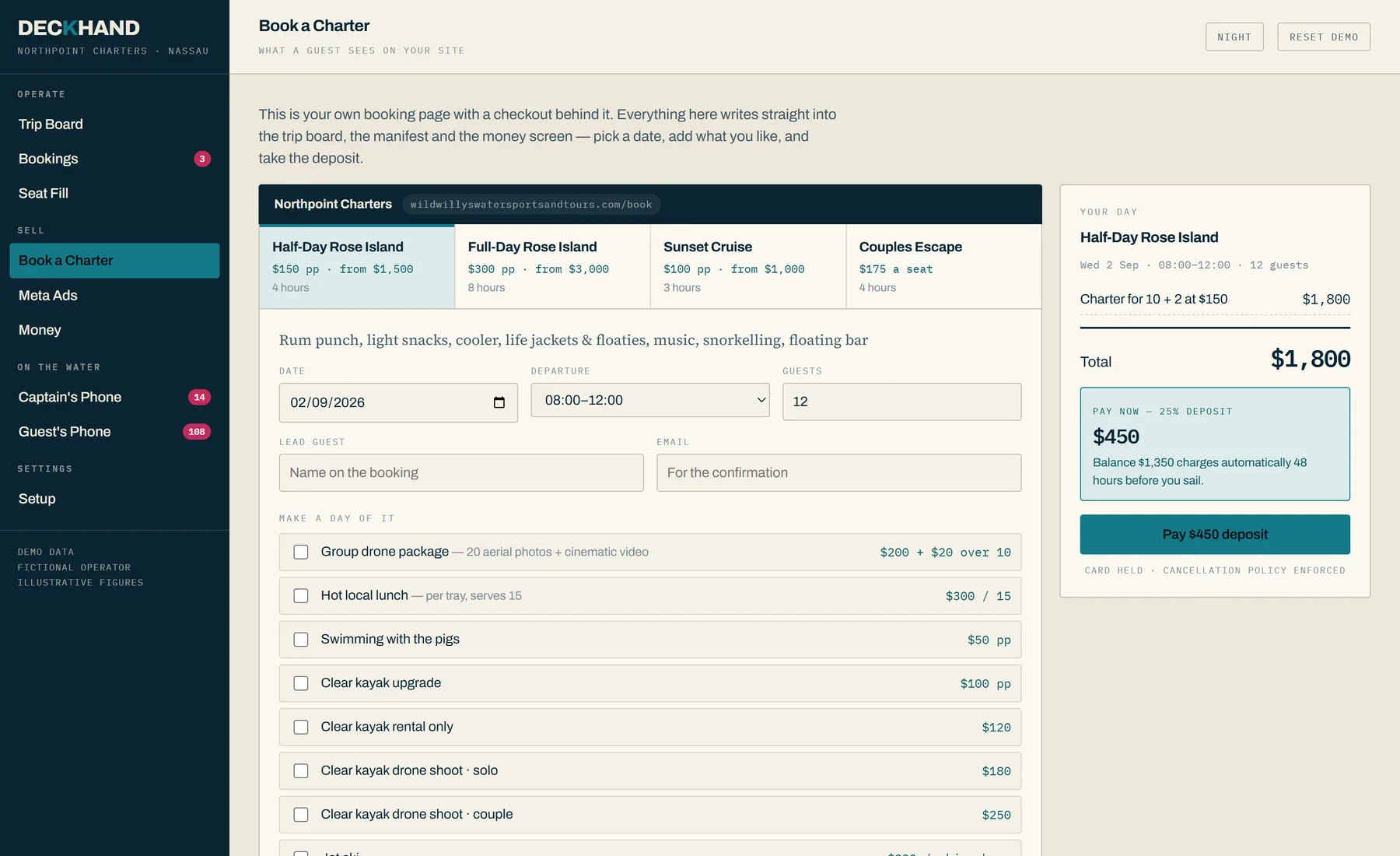
One board that is the truth
Every slot for six months on one screen, a seat-fill engine behind your shared departures, and channel control so a slot that fills anywhere closes everywhere. Money by tour, by hour and by channel.
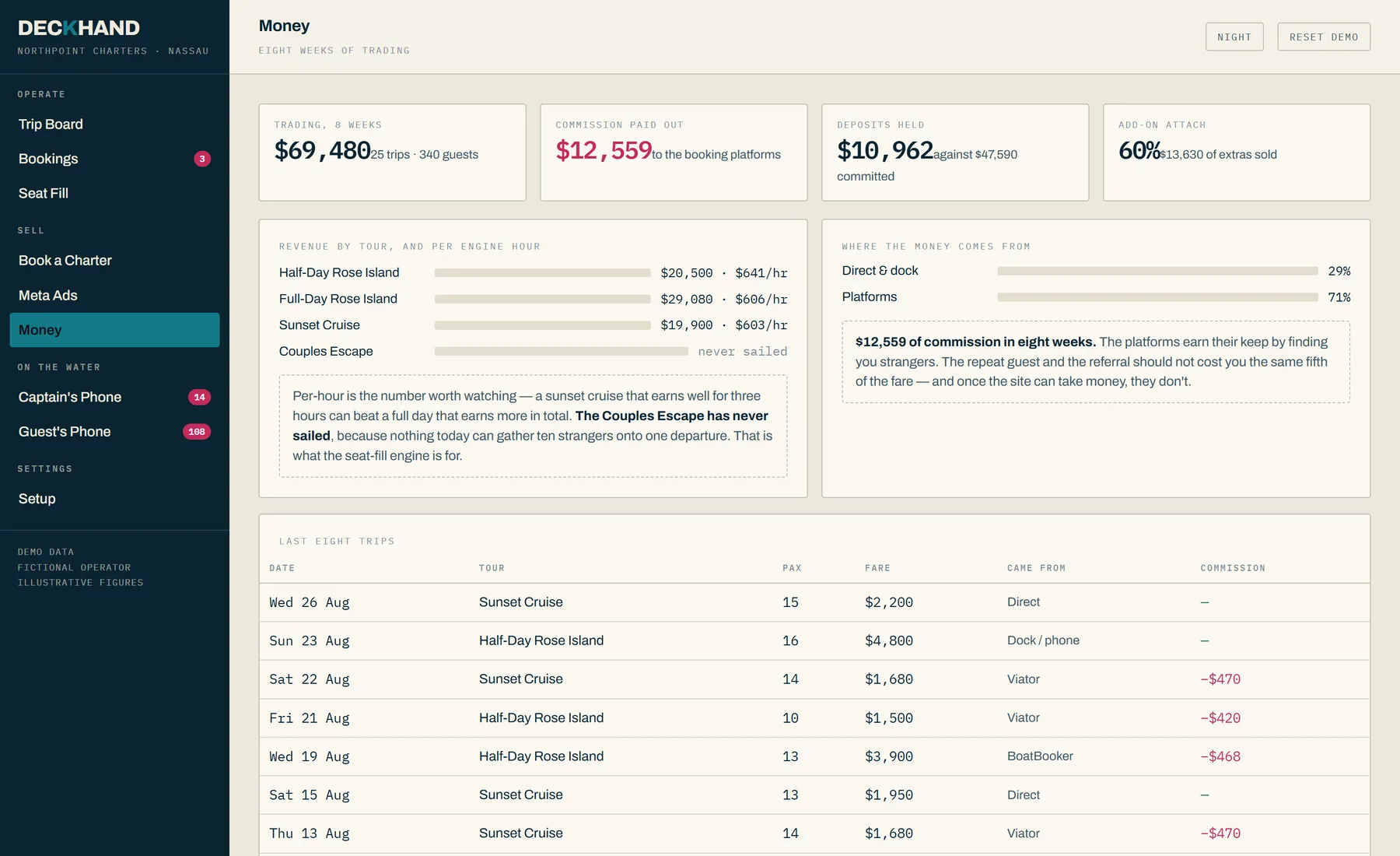
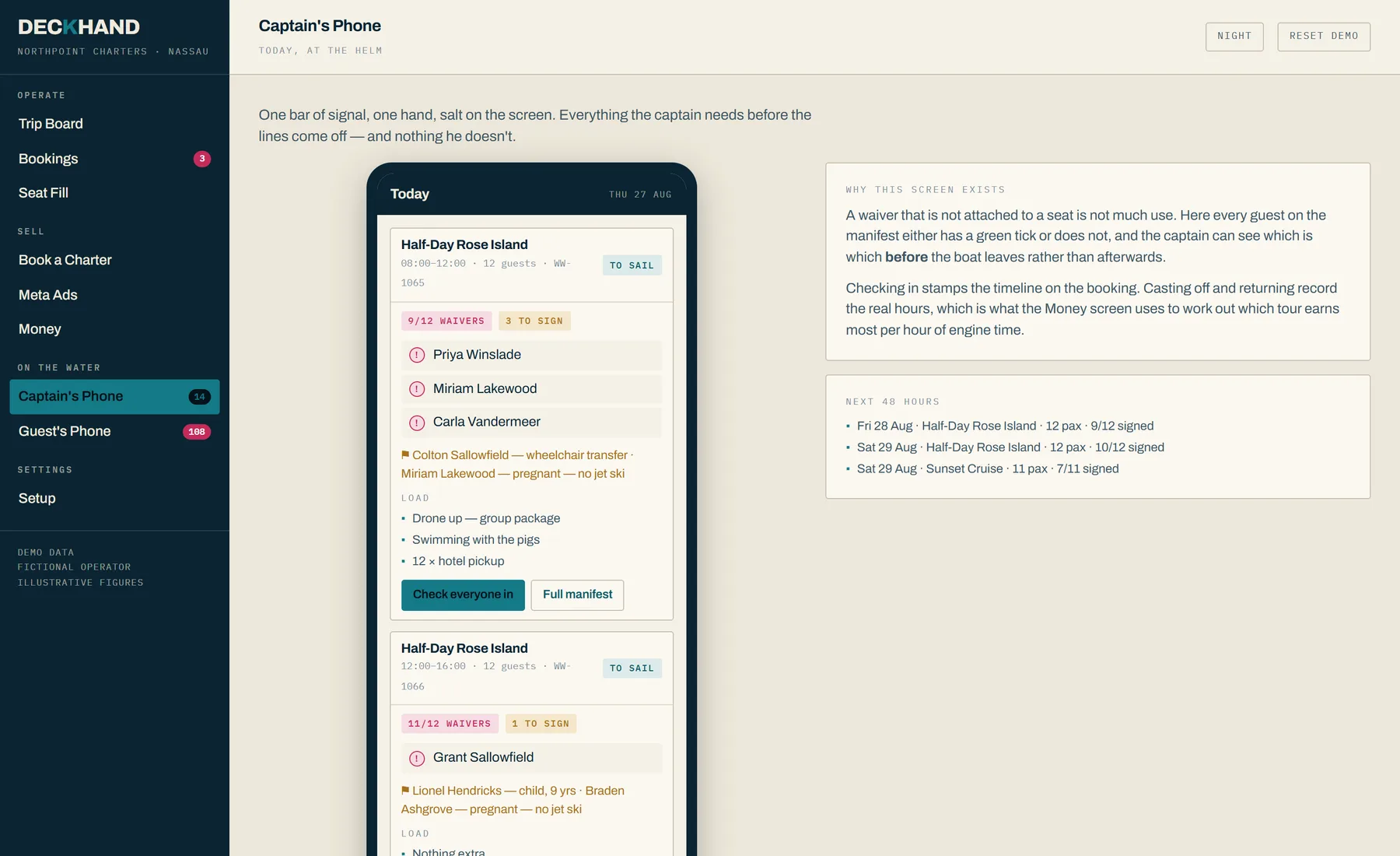
The morning runs itself
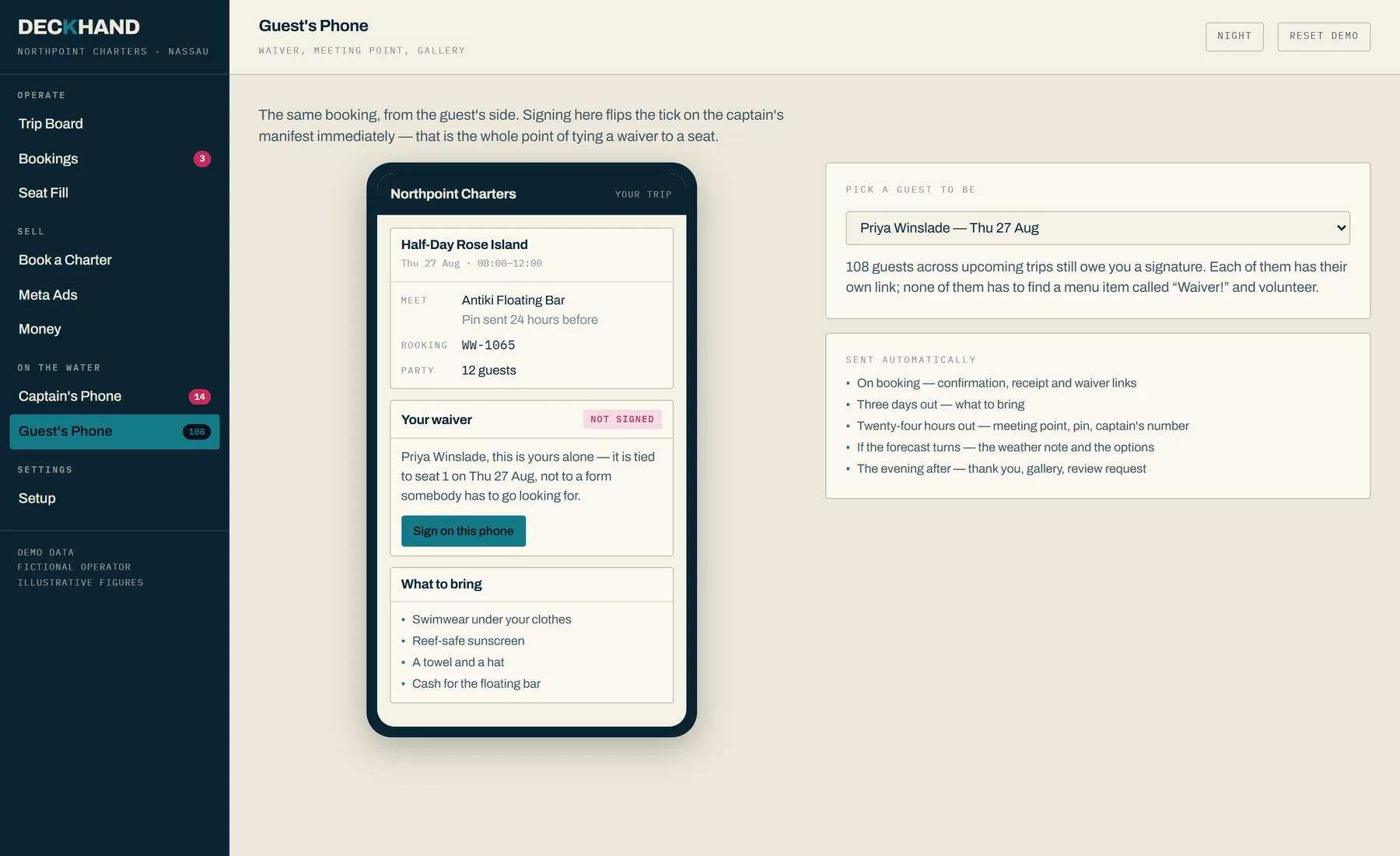
Waivers signed against a seat and shown on the manifest, with check-in blocked until they are. A captain's day view with headcounts and what to load — and a guest app carrying the meeting point, the pin and what to bring.
Advertising that reads the board
Campaigns optimised on real bookings rather than likes — pushing budget at thin dates and standing down the moment a boat is full. Reviews and photo delivery fire at the happiest moment, and unhappy guests are routed to you privately first.
Four phases, in the order that pays.
Sequenced so the parts that stop money leaking are live before the parts that spend money on advertising. Nothing goes live until you have used it yourself.
One catalogue, real availability, checkout with deposits, waivers tied to bookings.
Trip board, captain's day view, automatic guest messages, the seat-fill engine.
Business Manager in your name, tracking on real bookings, campaigns and reviews live.
Channel sync, yield by tour and hour, and ready for a second vessel.
Priced against what the platforms already take.
Viator and GetYourGuide charge 20–30% of every booking they send you, and keep the guest. Your booking platform adds a 6–8% fee your guest pays at checkout. Those are the numbers this sits against — not "what does software cost".
Season Readiness Review
A written review of how you take money, how you count seats, how the day gets run and what the channels actually cost you — plus your own tours at your own published prices running in a working system, yours to click through. Delivered inside a week. Credited in full against any build within 60 days.
The system, on your operation
All four decks, set up on your catalogue and your branding, with hosting, support and changes included. Twelve-month minimum, then cancellable on a month's notice. After the review credit, the first payment is $250 — about one guest on a half-day trip.
More than one boat, or a real group desk
Everything above, plus a multi-vessel board, the group and corporate desk end to end, crew rostering, channel sync with the platforms, and profit per vessel and per departure. One landed corporate booking generally covers the build.
Commission share
For an operator who will not sign a fixed cost in the off-season. You pay a small monthly fee and a share of what the system books directly — so it costs most in the months you can most afford it, and almost nothing in the months you cannot.
The off-season is charged at half
Nassau runs December to April. New England runs May to October. Declare up to four off-season months and they bill at half rate — a system you are not sailing behind should not cost what one you are does.
It earns before you pay for it
If the system has not taken its first paid direct booking within 30 days of going live, the monthly stops until it does. We control the build, so the risk of that is ours rather than yours.
Prices in USD. Ad spend, card processing fees, native app-store builds, new photography and hardware are never included — your ad spend goes direct from your card to Meta and the account stays in your name.
The ones operators actually ask
Do I have to replace my website?
No. In most cases the site keeps its look and its photographs and gains the machinery it never had — a checkout that holds dates, prices drawn from one catalogue, and pages built so search engines can show your price and rating.
We already use Viator and GetYourGuide. Does this replace them?
No, and it shouldn't. They put you in front of people who have never heard of you, which is worth paying for. What changes is that they stop being the only route that ends in a payment — you own the direct booking, the repeat and the referral, and the board keeps every channel honest about availability.
We already run FareHarbor / Peek / RezBS. Why would we need this?
Because none of them run the day. They are good at what they were built for — selling a seat and taking the card — and we leave that alone. What they were never built for is the group and corporate enquiry, the crew and vessel roster, the weather cancellation that has to rebook forty people, the provisioning count, the tips and the crew pay, and knowing what a Tuesday actually earned. That is the layer we build, on top of the one you already have.
What happens to guest data?
Waivers carry medical declarations, so where the data lives is a real question rather than a technical detail. In the Bahamas and Barbados we set out the options and you decide, including hosting in-country.
What does it cost?
The tiers are published above, which is unusual in this trade and deliberate — you should not have to sit through a call to find out whether we are in your range. Almost everyone starts with the $250 Season Readiness Review, because it is a real deliverable rather than a sales meeting and it comes straight off the build if you go ahead. Two things can still move a build price: how you take cards, and whether guest data has to be hosted in-country.
Start with the review, not a sales call.
$250, one week. You get the system standing up on your own trips at your own published prices — the same Saturday morning booked, paid, waivered and manifested — alongside a written read on where the money is leaking and what the channels are costing you. If you go ahead it comes off the build. If you don't, you keep the review.
No deck, no forms. Tell us the boat and where you sail, and we start.